
Horizon Texas Representatives Return from Calgary with Hope for the Church’s Future
October 27, 2026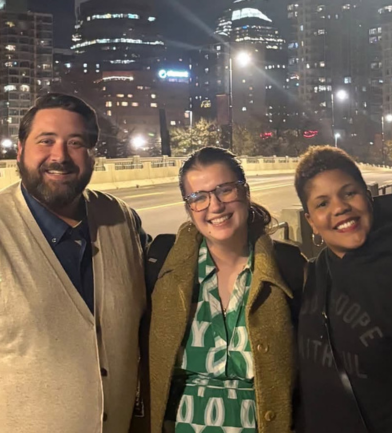
What kind of church do United Methodists want to become?
That question brought United Methodists from different countries, cultures and generations to Calgary Oct. 20-24 for the Council of Bishops Leadership Gathering, including three representatives from the Horizon Texas Conference: Rachel Shipley Blackwell, Rev. Dr. Chad Johnson and Melissa Clay.
Over several days, participants worshipped together, built relationships and worked in covenant groups to name realities facing the church and imagine new practices for its future.
Shipley Blackwell compared the event to a visioning retreat. “We’re not legislating. We’re not voting on anything,” she explained. “We’re taking time to build relationships and be in community with one another and to dream.”
For Johnson, that work began in worship and quickly moved into difficult questions about the church. He described celebrating Holy Communion not only with those gathered in Calgary, “but as members of the Body of Christ worldwide.”
Later, his covenant group wrestled with questions that would help frame its work.
“What is working? What is not working? Who is not present in our congregations and in our denomination, and why is that a reality?” Johnson said. “And how do we live into our baptismal vows in a deeply intentional way as we move forward as the people called The United Methodist Church?”
For Horizon Texas’ representatives, much of that work happened apart from one another. Participants were placed in covenant groups with United Methodists from different regions and contexts, bringing a diversity of perspectives to the conversations and making the church’s worldwide connection tangible.
“It is one thing to know that we are a connectional church and another entirely to see it in action,” Shipley Blackwell said.
Clay found an early sign of hope in the gathering’s opening worship. As the musicians began playing “Blessed Assurance,” she watched United Methodists from different countries and cultures begin to sing together.
“I thought right then, ‘There is hope,’” she said.
One of the distinctive experiences that shaped the week was encountering the breadth of the connection in worship and conversation.
Participants sang in multiple languages and shared different traditions of prayer. For Clay, hearing United Methodists pray and read scripture in their native languages was particularly moving. At another point, participants sang the same song together in their own languages.
“I was in awe and couldn’t stop smiling,” she said.
Conversations with United Methodists from other parts of the world also challenged assumptions about problems the church sometimes treats as universal.
For example, Shipley Blackwell said conversations about declining participation among young people are common in the U.S. But in her covenant group, she heard from people familiar with African contexts where young people are present and leading.
“The only way I know that is through being in conversation and being in relationship,” she said. “We have this gift of being connected to all of these other places. And so how are we opening ourselves up to learn?”
That emphasis on relationship became one of Shipley Blackwell’s clearest takeaways from the gathering.
She heard words such as equity and relationship surface across recommendations developed by groups working independently. Another idea stayed with her: co-creation.
“It’s not really enough to offer someone the ability to come into conversations if we’re not giving them meaningful authority over what’s happening in them,” she said.
The need to make room for new ways of being church surfaced elsewhere during the gathering. Johnson pointed to an image from Bishop Mande Muyombo that stayed with him: “We cannot have a 2026 car with a 1968 engine.”
For Johnson, the image underscored the need for the denomination to examine what is outdated or ineffective and be willing to adapt.
Clay similarly came away thinking about the church’s focus. She said she hopes to see The United Methodist Church become less focused on structures and more focused on people, community partnerships and building relationships.
Shipley Blackwell was also invited to serve on the gathering’s closing panel, where she reflected on the recommendations developed during the week and challenged participants to consider what United Methodists uniquely have to offer.
“The challenge I issued to the gathering during the closing panel was to get excited about this unique perspective we have to offer and to go out and share it,” she said.
Johnson also left Calgary looking ahead. He said he believes The United Methodist Church can become “a pioneer denomination” in bringing deep change to communities and across the connection. “A movement that is radically inclusive, carrying a bold missional priority,” he said.
The gathering was rooted in a belief that United Methodists can help build a better future for the church together. For Horizon Texas’ representatives, the work did not end when they left Calgary.
“I am encouraged, I am hopeful, I am ready to love boldly, serve joyfully, and lead courageously,” said Clay. “We have some work to do in The United Methodist Church.”
She left Calgary ready to be part of it.
To explore videos and other resources from the gathering, visit ResourceUMC. The Council of Bishops also plans to release a report with key takeaways from the gathering in January 2027.